

[Aug-2026 Newly Released] 300-740 Dumps for CCNP Security Certified
Updated Verified 300-740 dumps Q&As - 100% Pass
Cisco 300-740 Exam Syllabus Topics:
| Topic | Details |
|---|---|
| Topic 1 |
|
| Topic 2 |
|
| Topic 3 |
|
| Topic 4 |
|
| Topic 5 |
|
NEW QUESTION # 45
The main benefit of integrating threat intelligence into cloud security is:
- A. Decreasing the need for secure domains
- B. Increasing the complexity of security architectures
- C. Enhancing the ability to identify and respond to emerging threats
- D. Reducing the effectiveness of security operations
Answer: C
NEW QUESTION # 46
What does SASE integration aim to achieve in cloud security?
- A. Combine networking and security functions into a single framework
- B. Reduce the need for cloud security
- C. Provide a standalone security solution
- D. Decentralize security management
Answer: A
NEW QUESTION # 47 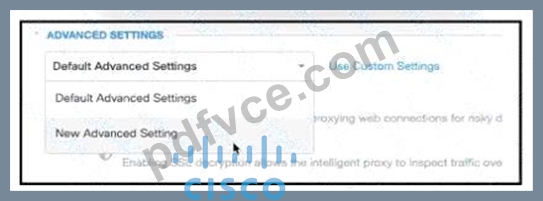
Refer to the exhibit. An engineer must configure a global allow list in Cisco Umbrella for the cisco.com domain. All other domains must be blocked. After creating a new policy and adding the cisco.com domain, the engineer attempts to access a site outside of cisco.com and is successful. Which additional Security Settings action must be taken to meet the requirement?
- A. Enforce SafeSearch.
- B. Limit Content Access.
- C. Apply Destination List.
- D. Enable Allow-Only Mode
Answer: D
Explanation:
When configuring Cisco Umbrella to block all traffic except to domains explicitly allowed (e.g., cisco.com), the "Allow-Only Mode" must be enabled. This setting overrides default behavior and ensures that only entries listed in the allow list are accessible-everything else is automatically blocked. According to SCAZT Section
1 (Cloud Security Architecture, Pages 16-19), enabling Allow-Only Mode is crucial for strict outbound DNS filtering.
Without this setting, the system allows access to all domains not explicitly blocked, which is why the engineer was able to access non-cisco.com domains despite defining an allow list.
Reference: Designing and Implementing Secure Cloud Access for Users and Endpoints (SCAZT), Section 1, Pages 16-19
NEW QUESTION # 48
Analyzing application dependencies is crucial for:
- A. Complicating application development and deployment
- B. Decreasing application performance deliberately
- C. Increasing the time needed for security compliance checks
- D. Identifying potential security risks and ensuring proper access controls are in place
Answer: D
NEW QUESTION # 49
A converged multicloud policy allows organizations to:
- A. Achieve consistent security and compliance across multiple cloud environments
- B. Avoid using public cloud services
- C. Focus solely on on-premises security
- D. Implement different security policies for each cloud provider
Answer: A
NEW QUESTION # 50
After containing a cybersecurity threat, the next step is to _________ the damage or vulnerability to prevent future incidents.
- A. exacerbate
- B. remediate
- C. escalate
- D. overlook
Answer: B
NEW QUESTION # 51 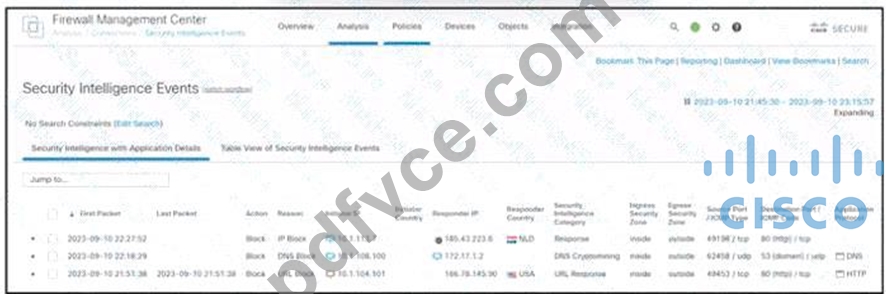
Refer to the exhibit. An engineer is analyzing a Cisco Secure Firewall Management Center report. Which activity does the output verify?
- A. A DNS request to IP address 172.17.1.2 was blocked.
- B. An HTTP response from IP address 10.1.104.101 was blocked.
- C. A DNS response from IP address 10.1.108.100 was blocked.
- D. An HTTP request to IP address 10.1.113.7 was blocked.
Answer: C
Explanation:
The exhibit shows DNS Block as the reason and lists 10.1.108.100 as the Responder IP, with the Initiator being 10.1.113.7. In Cisco Secure Firewall Management Center reports, the "Initiator IP" is the source of the request and the "Responder IP" is the source of the response. Since the DNS security intelligence engine flagged the traffic, and 10.1.108.100 was the responder, the blocked traffic corresponds to a DNS response from that IP.
Reference: Designing and Implementing Secure Cloud Access for Users and Endpoints (SCAZT), Section 5:
Visibility and Assurance, Pages 94-97
NEW QUESTION # 52
Which security policy is most relevant for controlling access to SaaS applications like Office 365, Workday, and Salesforce?
- A. Unlimited data transfer policies
- B. Implementing access control based on user identity and device security posture
- C. Blocking all cloud services to ensure network security
- D. Allowing all outbound traffic without inspection
Answer: B
NEW QUESTION # 53
A network administrator uses Cisco Umbrella to protect internal users from malicious content. A customer is using an IPsec tunnel to connect to an Umbrella Organization. The administrator was informed about a zero- day vulnerability that infects user machines and uploads sensitive data through the RDP port. The administrator must ensure that no users are connected to the internet using the RDP protocol. Which Umbrella configuration must the administrator apply?
- A. Web policy to block Remote Desktop Manager application type
- B. Data loss prevention policy to block all file uploads with RDP application mime type
- C. DNS policy to block Remote Desktop Manager application type
- D. Firewall policy and set port 3389 to be blocked for all outgoing traffic
Answer: D
Explanation:
The Remote Desktop Protocol (RDP) uses TCP port 3389. Cisco Umbrella includes a cloud-delivered firewall that can be used to block outbound traffic by port. In this case, since the RDP communication needs to be prevented regardless of application name resolution, the best approach is to use a Firewall policy in Umbrella to block port 3389 traffic across the tunnel.
Reference: Designing and Implementing Secure Cloud Access for Users and Endpoints (SCAZT), Section 3:
Network and Cloud Security, Pages 72-75.
NEW QUESTION # 54
Secure Domains in the SAFE framework are used to:
- A. Segregate network areas based on security requirements
- B. Categorize types of security threats
- C. Define different administrative roles
- D. Specify security policies for cloud providers
Answer: A
NEW QUESTION # 55
The primary purpose of Cisco Secure Analytics and Logging is to:
- A. Decrease the storage of logs and analytics data
- B. Simplify attacks on network infrastructure
- C. Enhance visibility into security and network events for better incident analysis
- D. Focus solely on external threat actors while ignoring insider threats
Answer: C
NEW QUESTION # 56 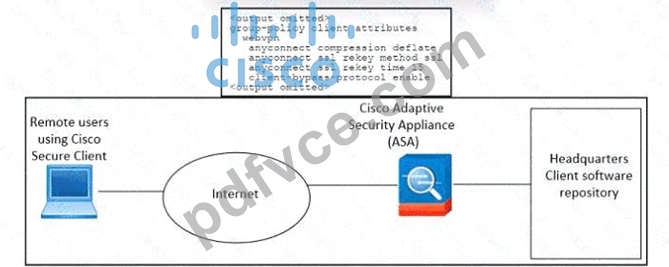
Refer to the exhibit. An engineer must configure Cisco ASA so that the Secure Client deployment is removed when the user laptop disconnects from the VPN. The indicated configuration was applied to the Cisco ASA firewall. Which command must be run to meet the requirement?
- A. client-bypass-protocol disable
- B. anyconnect keep-installer none
- C. anyconnect firewall-rule client-interface
- D. client-bypass-protocol enable
Answer: B
Explanation:
The anyconnect keep-installer none command is used to remove the Cisco Secure Client (formerly AnyConnect) from an endpoint once the VPN session ends. This is useful in temporary or kiosk-based access environments. The default behavior retains the client.
This capability is covered in SCAZT Section 2: User and Device Security (Pages 40-44), which outlines VPN session lifecycle management and Secure Client policies.
Reference: Designing and Implementing Secure Cloud Access for Users and Endpoints (SCAZT), Section 2, Pages 40-44
NEW QUESTION # 57
Web Application Firewalls (WAFs) protect against DDoS attacks by:
- A. Slowing down the application response time
- B. Inspecting incoming traffic and filtering out malicious requests
- C. Decreasing server resources
- D. Removing SSL encryption
Answer: B
NEW QUESTION # 58
The process of analyzing telemetry reports helps in:
- A. Determining the scope and impact of a security threat
- B. Ignoring critical security alerts
- C. Reducing the efficiency of security operations
- D. Focusing solely on external threats
Answer: A
NEW QUESTION # 59
What does SAML/SSO stand for and what is its purpose?
- A. Security Assertion Markup Language / Secure Sign-Out, to secure logouts across systems
- B. Single Access Markup Language / Single Sign-On, to simplify logins across different systems
- C. Secure Access Markup Language / Secure Sign-On, to increase login complexity
- D. Security Assertion Markup Language / Single Sign-On, to simplify logins across different systems
Answer: D
NEW QUESTION # 60
Security audit reports are crucial for:
- A. Promoting a false sense of security
- B. Eliminating the need for security policies
- C. Reducing the overall security budget
- D. Identifying compliance gaps and areas lacking sufficient security controls
Answer: D
NEW QUESTION # 61
An organization is distributed across several sites. Each site is connected to the main HQ using site-to-site VPNs implemented using Secure Firewall Threat Defense. Which functionality must be implemented if the security manager wants to send SaaS traffic directly to the internet?
- A. Policy-based routing
- B. ECMP routing
- C. Multi-instances
- D. IPsec tunnels
Answer: A
Explanation:
Policy-Based Routing (PBR) enables routing decisions based on criteria such as source IP, destination IP, or application. To send SaaS traffic (e.g., Office 365, Salesforce) directly to the internet rather than over a site-to- site VPN, PBR must be configured at each site firewall. According to SCAZT Section 1 (Cloud Security Architecture, Pages 18-20), this approach enables secure local internet breakout-commonly used in direct internet access (DIA) architectures.
Reference: Designing and Implementing Secure Cloud Access for Users and Endpoints (SCAZT), Section 1, Pages 18-20
NEW QUESTION # 62 
Refer to the exhibit. An engineer must configure SAML SSO in Cisco ISE to use Microsoft Azure AD as an identity provider. These configurations were performed:
* Configure a SAML IdP in ISE.
* Configure the Azure AD IdP settings.
Which two actions must the engineer take in Cisco ISE? (Choose two.)
- A. Configure the Internal Identity Source Sequence setting.
- B. Add a SAML IdP.
- C. Upload metadata from Azure AD to ISE.
- D. Configure the External Identity Sources settings.
- E. Configure SAML groups in ISE.
Answer: C,D
Explanation:
When integrating Cisco ISE with Azure AD using SAML SSO:
B: The Azure AD metadata must be uploaded into ISE to establish trust and allow token validation.
D: External Identity Sources settings must be configured in ISE to recognize and process authentication requests via SAML-based identity providers like Azure AD.
These are mandatory steps for enabling browser-based SSO authentication in ISE as explained in SCAZT Section 2 (User and Device Security, Pages 42-44), which describes federated identity integration.
Note: Option A is already completed as stated in the prompt. Options C and E are not essential to the authentication flow in this SAML context.
Reference: Designing and Implementing Secure Cloud Access for Users and Endpoints (SCAZT), Section 2, Pages 42-44
NEW QUESTION # 63 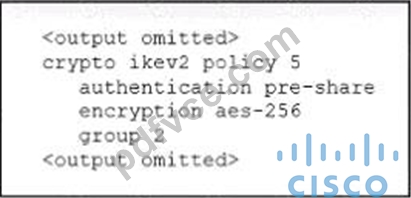
Refer to the exhibit. An engineer must configure a remote access IPsec/IKEv2 VPN that will use SHA-512 on a Cisco ASA firewall. The indicated configuration was applied to the firewall; however, the tunnel fails to establish. Which command must be run to meet the requirement?
- A. integrity sha512
- B. encryption sha512
- C. ipsec-proposal sha512
- D. protocol esp encryption sha512
Answer: A
Explanation:
In Cisco ASA configurations using IKEv2, the integrity command defines the hash algorithm. To use SHA-
512, the correct syntax is:
integrity sha512
Without this, the IKEv2 proposal is considered incomplete or mismatched with the peer. The encryption command sets encryption (AES-256, etc.), not hashing. The correct structure is:
crypto ikev2 policy <#>
encryption aes-256
integrity sha512
group 2
prf sha512
lifetime 86400
Reference: Designing and Implementing Secure Cloud Access for Users and Endpoints (SCAZT), Section 1:
Cloud Security Architecture, Pages 20-23
Reference: Designing and Implementing Secure Cloud Access for Users and Endpoints (SCAZT), Section 5, Pages 93-95
NEW QUESTION # 64
Endpoint posture policies are used to assess:
- A. The user's physical location
- B. The speed of the network connection
- C. The security readiness of a device before granting network access
- D. The user's personal preferences for software
Answer: C
NEW QUESTION # 65 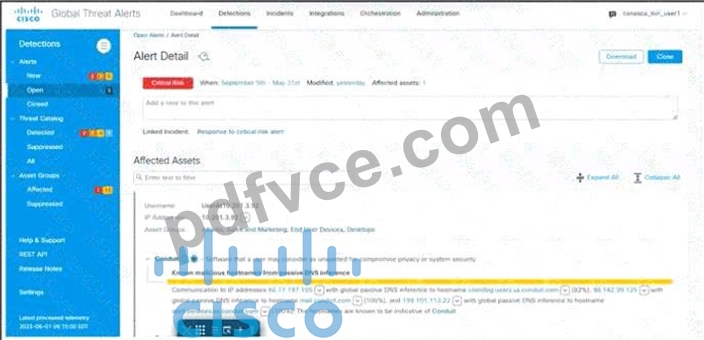
Refer to the exhibit. An engineer is investigating the critical alert received in Cisco Secure Network Analytics. The engineer confirms that the incident is valid. Which two actions must be taken? (Choose two.)
- A. Shut down the host.
- B. Quarantine the host
- C. Uninstall the Conduit software.
- D. Block IP address 66.77.197.165
- E. Inform the incident management team.
Answer: B,E
Explanation:
The alert identifies known malicious communication from a host with Conduit software installed. Conduit is flagged as spyware/malware by Cisco Secure Analytics.
A: Alerting the incident response team is standard procedure when high-priority threats are confirmed.
E: Quarantining the host via endpoint isolation (e.g., Secure Endpoint or network-based access control) is a critical action to prevent lateral movement.
Blocking the IP alone (B) does not stop internal damage. Shutting down the host (D) prematurely removes forensic evidence. Uninstalling the software (C) should occur later during recovery after analysis.
Reference: Designing and Implementing Secure Cloud Access for Users and Endpoints (SCAZT), Section 6, Pages 114-117
NEW QUESTION # 66
......
Latest 300-740 Exam Dumps Cisco Exam from Training: https://certification-questions.pdfvce.com/Cisco/300-740-exam-pdf-dumps.html