

Provide Palo Alto Networks PCNSE Dumps Updated Aug 29, 2026 With 375 QA's
Latest PCNSE Dumps for Success in Actual Palo Alto Networks Certified
Palo Alto Networks Certified Security Engineer (PCNSE) certification is a valuable certification for professionals who work with Palo Alto Networks' Next-Generation Firewalls (NGFWs). Palo Alto Networks Certified Network Security Engineer Exam certification exam is a comprehensive test of an individual's knowledge and skills in Palo Alto Networks' PAN-OS 10.0 operating system. Palo Alto Networks Certified Network Security Engineer Exam certification is recognized globally and is highly valued by organizations that use Palo Alto Networks' products and services. The PCNSE certification not only enhances an individual's career prospects but also provides organizations with a benchmark for hiring security professionals.
NEW QUESTION # 122
Refer to exhibit. An organization has Palo Alto Networks NGFWs that send logs to remote monitoring and security management platforms. The network team has reported excessive traffic on the corporate WAN.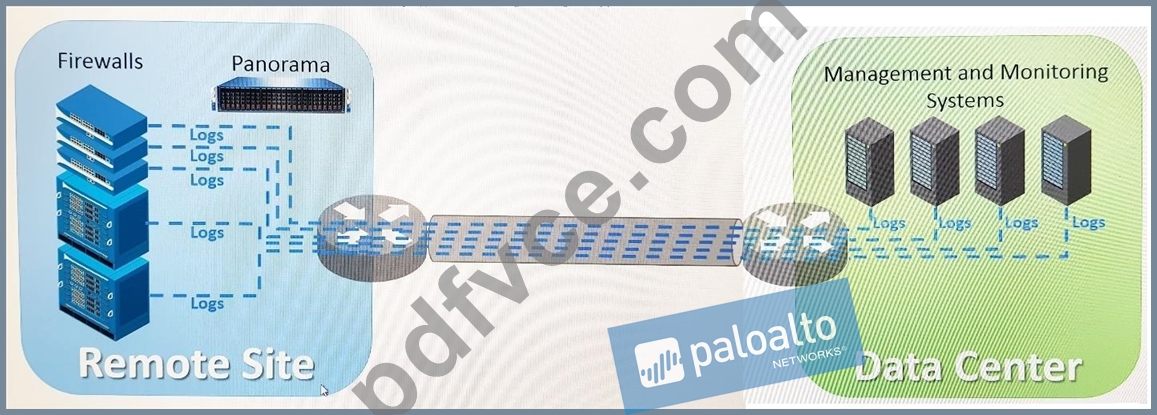
How could the Palo Alto Networks NGFW administrator reduce WAN traffic while maintaining support for all existing monitoring platforms?
- A. Configure log compression and optimization features on all remote firewalls.
- B. Any configuration on an M-500 would address the insufficient bandwidth concerns.
- C. Forward logs from firewalls only to Panorama and have Panorama forward logs to other external services.
- D. Forward logs from external sources to Panorama for correlation, and from Panorama send them to the NGFW.
Answer: C
Explanation:
https://docs.paloaltonetworks.com/panorama/10-0/panorama-admin/manage-log- collection/configure-syslog-forwarding-to-external-destinations.html#idb02b17f9-7dfc-40fd-919c- be699845ebdc
NEW QUESTION # 123
An engineer is monitoring an active/active high availability (HA) firewall pair.
Which HA firewall state describes the firewall that is experiencing a failure of a monitored path?
- A. Active-secondary
- B. Initial
- C. Passive
- D. Tentative
Answer: D
Explanation:
In an active/active high availability (HA) firewall pair, when a firewall experiences a failure of a monitored path, it enters the "Tentative" state1. This state indicates that the firewall is synchronizing sessions and configurations from its peer due to a failure or a change in monitored objects such as a link or path. The firewall in this state is not fully functional but is working towards resuming normal operations by syncing with its peer. Therefore, the correct answer is B. Tentative.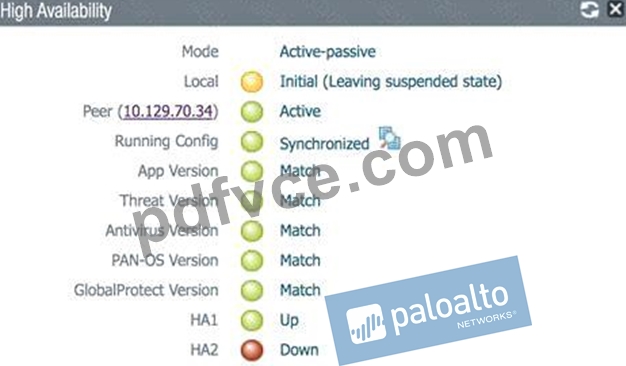
NEW QUESTION # 124
An administrator is defining protection settings on the Palo Alto Networks NGFW to guard against resource exhaustion. When platform utilization is considered, which steps must the administrator take to configure and apply packet buffer protection?
- A. Enable and then configure Packet Buffer thresholds
Enable Interface Buffer protection. - B. Enable and configure the Packet Buffer protection thresholds.
Enable Packet Buffer Protection per ingress zone. - C. Enable per-vsys Session Threshold alerts and triggers for Packet Buffer Limits.
Enable Zone Buffer Protection per zone. - D. Create and Apply Zone Protection Profiles in all ingress zones.
Enable Packet Buffer Protection per ingress zone. - E. Configure and apply Zone Protection Profiles for all egress zones.
Enable Packet Buffer Protection pre egress zone.
Answer: B
Explanation:
https://www.paloaltonetworks.com/documentation/80/pan-os/pan-os/zone-protection-and-dos- protection/configure-zone-protection-to-increase-network-security/configure-packet-buffer- protection
NEW QUESTION # 125
Which DoS protection mechanism detects and prevents session exhaustion attacks?
- A. Resource Protection
- B. TCP Port Scan Protection
- C. Flood Protection
- D. Packet Based Attack Protection
Answer: A
Explanation:
Explanation/Reference: https://www.paloaltonetworks.com/documentation/80/pan-os/pan-os/zone-protection-and-dos- protection/zone-defense/dos-protection-profiles-and-policy-rules/dos-protection-profiles
NEW QUESTION # 126
What happens, by default, when the GlobalProtect app fails to establish an IPSec tunnel to the GlobalProtect gateway?
- A. It stops the tunnel-establishment processing to the GlobalProtect gateway immediately.
- B. It tries to establish a tunnel to the GlobalProtect gateway using SSL/TLS.
- C. It tries to establish a tunnel to the GlobalProtect portal using SSL/TLS.
- D. It keeps trying to establish an IPSec tunnel to the GlobalProtect gateway.
Answer: B
Explanation:
The GlobalProtect VPN solution by Palo Alto Networks is designed to provide secure remote access to users. It primarily attempts to establish a VPN tunnel using the IPSec protocol for optimal security and performance. However, in cases where IPSec cannot be used due to network restrictions or other issues, GlobalProtect has a fallback mechanism.
C . It tries to establish a tunnel to the GlobalProtect gateway using SSL/TLS:
If the GlobalProtect app fails to establish an IPSec tunnel with the GlobalProtect gateway, the default behavior is to fallback to SSL/TLS for tunnel establishment. This ensures that the VPN connection can still be established, maintaining secure remote access for the user even in environments where IPSec is not feasible. SSL/TLS provides a secure tunnel, albeit generally with slightly less efficiency than IPSec.
This fallback mechanism is part of the GlobalProtect app's design to ensure reliability and continuous secure access for remote users under various network conditions.
NEW QUESTION # 127
A firewall should be advertising the static route 10 2 0 0/24 into OSPF The configuration on the neighbor is correct but the route is not in the neighbor's routing table
Which two configurations should you check on the firewall'? (Choose two )
- A. Ensure that the OSPF neighbor state is "2-Way"
- B. Within the redistribution profile ensure that Redist is selected
- C. In the OSFP configuration ensure that the correct redistribution profile is selected in the OSPF Export Rules section
- D. In the redistribution profile check that the source type is set to "ospf"
Answer: B,C
Explanation:
https://docs.paloaltonetworks.com/pan-os/9-0/pan-os-web-interface-help/network/network-virtual-routers/ospf/ospf-export-rules-tab
https://knowledgebase.paloaltonetworks.com/KCSArticleDetail?id=kA10g000000ClGTCA0
NEW QUESTION # 128
What is the best description of the Cluster Synchronization Timeout (min)?
- A. The maximum interval between hello packets that are sent to verify that the HA functionality on the other firewall is operational
- B. The time that a passive or active-secondary firewall will wait before taking over as the active or active-primary firewall
- C. The maximum time that the local firewall waits before going to Active state when another cluster member is preventing the cluster from fully synchronizing
- D. The timeframe within which the firewall must receive keepalives from a cluster member to know that the cluster member is functional
Answer: C
Explanation:
The best description of the Cluster Synchronization Timeout (min) is the maximum time that the local firewall waits before going to Active state when another cluster member is preventing the cluster from fully synchronizing. This is a parameter that can be configured in an HA cluster, which is a group of firewalls that share session state and provide high availability and scalability. The Cluster Synchronization Timeout (min) determines how long the local firewall will wait for the cluster to reach a stable state before it decides to become Active and process traffic. A stable state means that all cluster members are either Active or Passive, and have synchronized their sessions with each other. If there is another cluster member that is in an unknown or unstable state, such as Initializing, Non-functional, or Suspended, then it may prevent the cluster from fully synchronizing and cause a delay in traffic processing. The Cluster Synchronization Timeout (min) can be set to a value between 0 and 30 minutes, with a default of 0. If it is set to 0, then the local firewall will not wait for any other cluster member and will immediately go to Active state. If it is set to a positive value, then the local firewall will wait for that amount of time before going to Active state, unless the cluster reaches a stable state earlier12. References: Configure HA Clustering, PCNSE Study Guide (page 53) How to Set Session, TCP, and UDP Timeout Values - Palo Alto Networks ...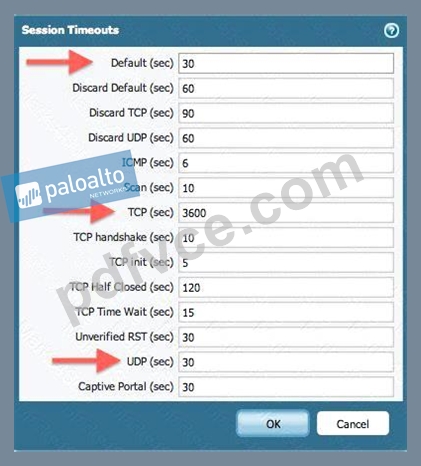
NEW QUESTION # 129
In a Panorama template which three types of objects are configurable? (Choose three)
- A. HIP objects
- B. QoS profiles
- C. interface management profiles
- D. security profiles
- E. certificate profiles
Answer: B,C,E
Explanation:
Explanation
https://docs.paloaltonetworks.com/panorama/9-1/panorama-admin/manage-firewalls/use-case-configure-firewall
NEW QUESTION # 130
Which statement accurately describes service routes and virtual systems?
- A. Virtual systems that do not have specific service routes configured inherit the global service and service route settings for the firewall.
- B. Virtual systems can only use one interface for all global service and service routes of the firewall.
- C. Virtual systems cannot have dedicated service routes configured; and virtual systems always use the global service and service route settings for the firewall.
- D. The interface must be used for traffic to the required external services.
Answer: A
NEW QUESTION # 131
The UDP-4501 protocol-port is to between which two GlobalProtect components?
- A. GlobalProtect app and GlobalProtect portal
- B. GlobalProtect portal and GlobalProtect gateway
- C. GlobalRrotect app and GlobalProtect gateway
- D. GlobalProtect app and GiobalProtect satellite
Answer: C
NEW QUESTION # 132
An engineer must configure the Decryption Broker feature. To which router must the engineer assign the decryption forwarding interfaces that are used in Decryption Broker security chain?
- A. A virtual router that has no additional interfaces for passing data-type traffic and no other configured routes than those used for the security chain.
- B. The virtual router that routes the traffic that the Decryption Broker security chain inspects.
- C. A virtual router that is configured with at least one dynamic routing protocol and has at least one entry in the RIB
- D. The default virtual router. If there is no default virtual router , the engineer must create one during setup.
Answer: B
Explanation:
Explanation
Decryption Broker is a feature that allows you to use a Palo Alto Networks firewall as a decryption broker for other security devices in your network . It works by decrypting traffic on one interface and forwarding it to another interface where it can be inspected by other devices before being re-encrypted and sent to its destination2. The firewall acts as a transparent bridge between the two interfaces and does not change the source or destination IP addresses of the traffic To configure Decryption Broker, you need to assign decryption forwarding interfaces (DFIs) to the virtual router that routes the traffic that you want to inspect. The DFIs are used to forward decrypted traffic from one interface to another in a security chain . A security chain is a set of devices that perform different security functions on the same traffic flow . You can have multiple security chains for different types of traffic or different segments of your network The reason why you need to assign DFIs to the virtual router that routes the traffic is because Decryption Broker uses routing tables to determine which DFI belongs to which security chain and how to forward traffic between them2. If you assign DFIs to a different virtual router than the one that routes the traffic, Decryption Broker will not be able to find them or forward traffic correctly
NEW QUESTION # 133
When you configure a Layer 3 interface what is one mandatory step?
- A. Configure Interface Management profiles which need to be attached to each Layer 3 interface
- B. Configure service routes to route the traffic for each Layer 3 interface
- C. Configure virtual routers to route the traffic for each Layer 3 interface
- D. Configure Security profiles, which need to be attached to each Layer 3 interface
Answer: C
Explanation:
In a Layer 3 deployment, the firewall routes traffic between multiple ports. Before you can Configure Layer 3 Interfaces, you must configure the Virtual Routers that you want the firewall to use to route the traffic for each Layer 3 interface.
https://docs.paloaltonetworks.com/pan-os/10-1/pan-os-networking-admin/configure- interfaces/layer-3-interfaces
NEW QUESTION # 134
While troubleshooting an issue, a firewall administrator performs a packet capture with a specific filter. The administrator sees drops for packets with a source IP address of 10.1.1.1.
How can the administrator further investigate these packet drops by looking at the global counters for this packet capture filter?
- A. > debug dataplane packet-diag set capture stage drop
- B. > show counter global filter delta yes I match 10.1.1-1
- C. > show counter global filter packet-filter yes delta yes
- D. > show counter global filter severity drop
Answer: C
NEW QUESTION # 135
A network security administrator has an environment with multiple forms of authentication. There is a network access control system in place that authenticates and restricts access for wireless users, multiple Windows domain controllers, and an MDM solution for company-provided smartphones. All of these devices have their authentication events logged.
Given the information, what is the best choice for deploying User-ID to ensure maximum coverage?
- A. captive portal
- B. Syslog listener
- C. agentless User-ID with redistribution
- D. standalone User-ID agent
Answer: D
NEW QUESTION # 136
An administrator plans to install the Windows-Based User-ID Agent to prevent credential phishing.
Which installer package file should the administrator download from the support site?
- A. Talnstall-11.0.0.msi
- B. GlobalProtect64-6.2.1.msi
- C. Ualnstall-11.0.0msi
- D. UaCredlnstall64-11.0.0.msi
Answer: D
NEW QUESTION # 137
View the GlobalProtect configuration screen capture.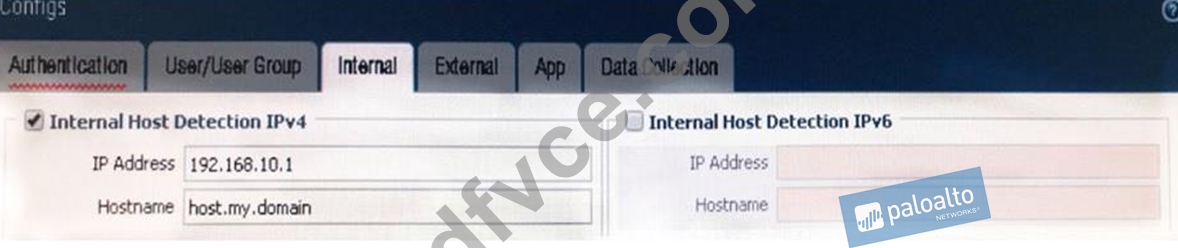
What is the purpose of this configuration?
- A. It enables a client to perform a reverse DNS lookup on 192.168.10.1 to detect that it is an internal client.
- B. It forces an internal client to connect to an internal gateway at IP address 192.168.10.1.
- C. It forces the firewall to perform a dynamic DNS update, which adds the internal gateway's hostname and IP address to the DNS server.
- D. It configures the tunnel address of all internal clients to an IP address range starting at 192.168.10.1.
Answer: A
Explanation:
Reference:
https://www.paloaltonetworks.com/documentation/80/globalprotect/globalprotect-admin-guide/globalprotect-portals/define- the-globalprotect-client-authentication-configurations/define-the-globalprotect-agent-configurations
"Select this option to allow the GlobalProtect agent to determine if it is inside the enterprise network. This option applies only to endpoints that are configured to communicate with internal gateways.
When the user attempts to log in, the agent does a reverse DNS lookup of an internal host using the specified Hostname to the specified IP Address. The host serves as a reference point that is reachable if the endpoint is inside the enterprise network. If the agent finds the host, the endpoint is inside the network and the agent connects to an internal gateway; if the agent fails to find the internal host, the endpoint is outside the network and the agent establishes a tunnel to one of the external gateways"
NEW QUESTION # 138
......
Palo Alto Networks PCNSE certification program is recognized as a leading certification in the industry. It is designed to help professionals stay up-to-date with the latest technologies and best practices in network security. Palo Alto Networks Certified Network Security Engineer Exam certification program provides a comprehensive understanding of network security concepts and hands-on experience with the Palo Alto Networks platform. The program is ideal for professionals who want to improve their skills and demonstrate their expertise in network security.
Changing the Concept of PCNSE Exam Preparation 2026: https://certification-questions.pdfvce.com/Palo-Alto-Networks/PCNSE-exam-pdf-dumps.html