

Best Preparations of L4M8 Exam 2023 CIPS Level 4 Diploma in Procurement and Supply Unlimited 106 Questions
Focus on L4M8 All-in-One Exam Guide For Quick Preparation.
The Chartered Institute of Procurement and Supply (CIPS) offers various certification programs to recognize the competency and expertise of procurement and supply chain professionals. Among these programs is the CIPS L4M8 Certification Exam, which focuses on Procurement and Supply in Practice. Procurement and Supply in Practice certification is designed to enhance the knowledge and competence of professionals in the procurement and supply chain field and help them progress their career.
CIPS L4M8 (Procurement and Supply in Practice) Certification Exam is a prestigious certification program that is designed to equip procurement and supply chain professionals with the skills and knowledge needed to excel in their careers. Procurement and Supply in Practice certification is offered by the Chartered Institute of Procurement and Supply (CIPS), an internationally recognized professional body that sets the standard for procurement and supply chain management.
NEW QUESTION # 58
Which four procurement cycle stages happen after the award of the contract?
Answer:
Explanation:
The procurement cycle is the heart of purchasing, sourcing and supplying and should be followed in day-to-day practice in the industry. The procurement cycle has thirteen stages. Contract award is stage 9, and the stages after the contract award are; Stage 10: ware house, logistic and receipt Stage 11: Contract performance review and continuous improvement Stage 12: SRM/SCM and contract management Stage 13: Asset management, lessons learned, end of life.
NEW QUESTION # 59
Why is it important to keep ethical codes of practice up to date?
Answer:
Explanation:
A code of ethics is a set of morals and principle set out by an organization to state what it deems to be acceptable conduct and behavior An ethical code of practice is a continually changing and developing document with society changing and different suppliers coming to market, the document has to remain current Suppliers should continually monitor their codes of ethics to ensure that;
1. They are looking after the interest of the supply chain
2. That potential customers can be reassured that they are conforming to the required regulation, e.g. ISO 14001.
Ethical code of conduct should be constantly monitored and updated in accordance with the changes organization faces. This include 1) Define (2) prevent (3) detect (4) reprove (5) evaluate.
NEW QUESTION # 60
What happens in the public sector, regarding providing feedback?
Answer:
Explanation:
A sector is an area of an industry, e.g., private, public or third sector.
A public sector is a sector of the economy that is owned, finance and run by the government. This sector is financed with tax payer's money. And therefore owe the general public an ethical explanation towards all investment and decision.
Once the supplier that is awarded the contract has accepted, the buyer can tell the unsuccessful bidders. This usually happens through email or letter. The public sector is more likely to give feedback to unsuccessful bidders and also have to respond to any stakeholders that request information on why a supplier is not successful.
NEW QUESTION # 61
What are the 3Ps in the triple bottom line.
Answer:
Explanation:
Trying to measure how sustainable an organization was use to be challenging undertaking. However, during the 1990s, a concept brought up by American John Elkington change the way sustainability was measured. This framework is known as the triple bottom line (TBL) and measures sustainability in relation to organizational performance and investment against the 3Ps (1) Profits (2) People (3) Planet. For example; Profit: A packaging manufacturer reinvesting its profits in State- of-the-art recycling machinery for it wasted cardboard.
People: A large privately owned call centre donate its end of life computers to a local youth clubs and social groups to help gain internet cases.
Planet: A driving instructors using only hybrid vehicles to teach her learners, thus to reducing Co2 emission.
NEW QUESTION # 62
Explain how procurement should decide whether to make or buy a product or service.
Answer:
Explanation:
Make or buy decision are about whether a products or services should be made within the organization or bought-in from an external supplier.
For a procurement professional to establish which method (make or buy) offers the best value, the item in question must be thought through if it is core to the organization and which option will add more value to the organization, as regards achieving its strategic goals. If it is core the procurement professional decide to make it and if it is not core the product or services can be bought in.
NEW QUESTION # 63
What matrix helps to define how to manage stakeholders?
Answer:
Explanation:
Stakeholders are individuals or organizations who are directly affected by a decision for example, community, shareholders, employees, suppliers, distributors, customers etc. stakeholders can be internal (employers, staffs), connected (such as suppliers, shareholders, financers and customers) external (Government, pressure groups, and community).
The matrix that helps define how to manage stakeholders is mendelow's stakeholders manage-ment matrix. This matrix is based on the theory that the level of management stakeholders require depends on the level of their power and interest within the project or organization The matrix groups stakeholders in to four quadrants according to their power and interest and ad-vice how to manage them.
1) Low power - Low interest (minimum effort)
2) Low power - High interest (keep inform)
3) High power - Low interest (keep satisfied)
4) High power - high interest (manage closely)
NEW QUESTION # 64
What are the four stages of decommissioning?
Answer:
Explanation:
When a fixed asset reaches the end of its life, it requires decommissioning before reconditioning or disposal.
Decommissioning is to observe all the safety measures and technical procedures and stop active machinery or an asset from operation (example gas plan, generator, transformer etc.
Decommissioning process include the following aspect
1) Preparation: Plan the process
2) Dismantle: Take the asset apart and remove hazardous waste
3) Processing: make safe any hazardous waste
4) Disposal: Ensure paper work is received to confirm removal and disposal
NEW QUESTION # 65
Explain which factors should be considered when deciding the quantity of a product to order.
Answer:
Explanation:
When reviewing supplier's response the procurement professional should consider the right quantity of product or service that has to be ordered at anytime as against the price to decide how to gain the best cost.
Factors to consider include the following
(1)Cost of inventory
(2) cost of insurance
(3) cost of transportation.
These three should be considered against price.
Note: Incoterms are versatile and procurement professionals should understand how they are ap-plied and what point the risk transfers from being the supplier's responsibility to being the buyer's responsibility. It is important to consult the ICC for the most recent definitions, but in the following questions (101-111) you can understand the rules.
Note: sharpen your knowledge on INCOTERMS. Please consider the following Objective Re-sponse questions
NEW QUESTION # 66
How can procurement professionals select suppliers?
Answer:
Explanation:
During the sourcing stage of the procurement cycle, the procurement professional needs to identify and select suppliers to fulfill the business needs. Supplier selection involves evaluating suppliers against predetermine criteria to assess their suitability in working with the buying organization. Suppliers can be evaluated according to Carter's 10Cs which are as follows: (1) Competency (2) capacity (3) consistency (4) control (5) cost (6) commitment (7) cash (8) Clean (9) culture (10) communication.
Procurement professionals can decide to evaluate and select suppliers based on the overall strategy and the business objectives. After that, it most suitable suppliers receive the documentation (Invitation to tender/ request for quotation).
NEW QUESTION # 67
What effect is technology having on jobs within an organization with which you are familiar with?
Answer:
Explanation:
With the ever developing use of technology, organizations are often under pressure to keep up with numerous technological advances. Jobs could be created in line with technology. Advances in technology can also results in lack of requirement for human impact and as such, jobs could be lost. Though it can help save time and retain bulk files in no space.
NEW QUESTION # 68
What Incoterm applies here?
The supplier is responsible of placing the goods in the hands of a chosen carrier by the buyer, at which point the buyer takes on the risk.
- A. FCA - Free Career
- B. EXW - Ex Works
- C. CPT - Carriage Paid To
- D. CIP - Carriage and Insurance Paid to
Answer: A
NEW QUESTION # 69
KPI should be written to match which area of an organization?
Answer:
Explanation:
Key performance indicator (KPI) is another method of monitoring how a supplier is delivering on a contract.
When creating KPIs to manage suppliers and their contracts the areas monitored should be related to the organization's overall strategy that is where organization's success will be measured.
NEW QUESTION # 70
What Incoterm applies here?
The supplier is responsible for delivering the goods to a carrier or to an intermediate agreed place. From this point, the buyer is responsible for ensuring these goods reach their named destination.
- A. CPT - Carriage Paid To
- B. EXW - Ex Works
- C. FCA - Free Career
- D. CIP - Carriage and Insurance Paid to
Answer: A
NEW QUESTION # 71
What does the acronym SMART stand for?
Answer:
Explanation:
When the procurement professional is setting key performance indicator (KPI) where which the supplier performance will be monitored and managed. The KPI is expected to be SMART. SMART is an acronym that is used to set KPI and specification.
S - specific ,
M - measurable,
A - achievable,
R - relevant, and
T - timebound.
NEW QUESTION # 72
Create a list of assets of a company with which you're familiar and divide them into standard and bespoke categorizing.
Answer:
Explanation:
Name of company: Full power projects
Business: Project management training and consultancy
If an organization is sourcing an asset that is readily available or mass produced then the cost associated with the design and manufacturing will be lower percentage of the total cost than if an organization commissions a bespoke piece of equipment to be designed and manufactured.
The following are a list of assets owned by fullpower projects.
Standard/off the shelf (Mass produced)
Projector from a shop-displayed files and document jackets from market
Desks and furniture
Bespoke/specialist - white board and marker
With extra, e.g. made with company color
Gift/ sovereign (bags and T. shirt) with coup any label, color and design Refer to the question column for response
NEW QUESTION # 73
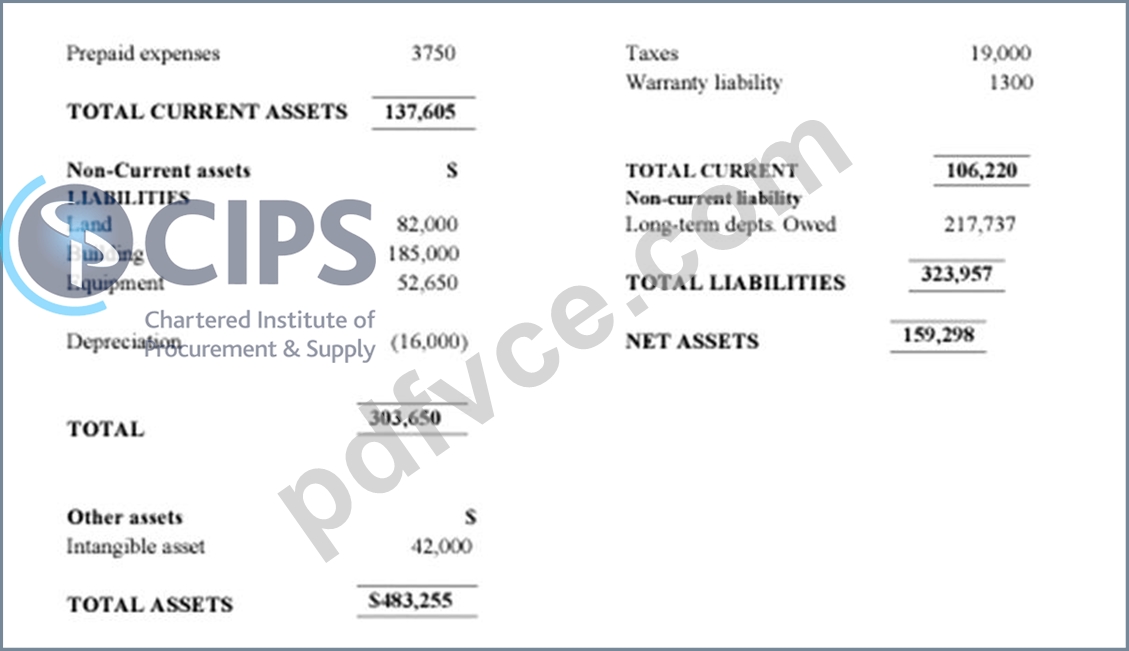
Use the balance sheet below to work out the correct ratio for coffee Time and explain whether the company appears to have enough assets to cover it liability.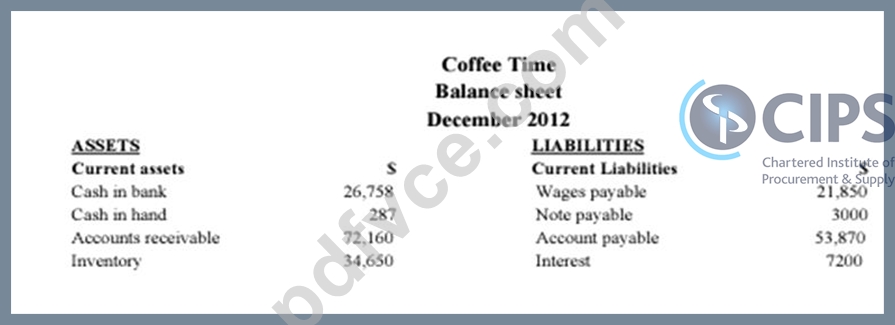
Answer:
Explanation:
The current ratio is one of the two was to determine organizations liquidity (how quickly its assets can be converted into cash)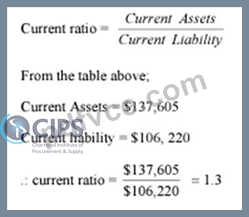
A current ratio of 1 shows that the organization has enough assets to repay (cover) it liability Buyers can be encouraged to deal with these suppliers after if they considered proven and strong in other areas.
NEW QUESTION # 74
What are the definition of a new buy and a modified re-buy?
Answer:
Explanation:
A new buy is the purchase of goods and services by an organization or an individual for its first time. For example a transport organization for the very first time contracting the purchase of a Lorry out to an external supplier. In situations like this, it is advisable to start the procurement cycle from the very first stage. Which is understanding the need and developing high level specification.
Modified re-buy is the purchase of goods or services that an organization has bought before there was a need but with changes to the specification or supplier or quantity or quality. In carrying out modified re-buy, procurement professional should start from the very first stage of the procurement cycle to justify the added need and follow through. Not in all cases that buyer would have to start from understanding the need. In a situation where the changes required is a change of supplier, the organization will start from its preferred suppliers list and contract the next ranking supplier as the case may be.
NEW QUESTION # 75
......
Guaranteed Success with L4M8 Dumps: https://certification-questions.pdfvce.com/CIPS/L4M8-exam-pdf-dumps.html