

Practice Oracle Cloud Solutions Infrastructure 1z0-1085-22 exam. Online Exam Practice Tests with detailed explanations! Pass 1z0-1085-22 with confidence!
1z0-1085-22 - Oracle Cloud Infrastructure 2022 Foundations Associate Practice Tests 2023 | PDFVCE
NEW QUESTION # 38
Which Oracle Cloud Infrastructure service leverages Terraform to configure infrastructure as code?
- A. Events
- B. Compartment Explorer
- C. Oracle Functions
- D. Resource Manager
Answer: D
Explanation:
Resource Manager is an Oracle Cloud Infrastructure service that allows you to automate the process of provisioning your Oracle Cloud Infrastructure resources. Using Terraform, Resource Manager helps you install, configure, and manage resources through the "infrastructure-as-code" model.
A Terraform configuration codifies your infrastructure in declarative configuration files. Resource Manager allows you to share and manage infrastructure configurations and state files across multiple teams and platforms. This infrastructure management can't be done with local Terraform installations and Oracle Terraform modules alone. For more information about the Oracle Cloud Infrastructure Terraform provider, see Terraform Provider. For a general introduction to Terraform and the "infrastructure-as-code" model, see https://www.terraform.io.
NEW QUESTION # 39
Which three components are part of Oracle Cloud Infrastructure (OCI) identity and access management service?
- A. Users
- B. Roles
- C. Compute Instances
- D. Regional Subnets
- E. Dynamic Groups
- F. Virtual Cloud Networks
- G. Policies
Answer: A,E,G
Explanation:
Components of IAM
IAM uses the components described in this section. To better understand how the components fit together, see Example Scenario.
RESOURCE
The cloud objects that your company's employees create and use when interacting with Oracle Cloud Infrastructure. For example: compute instances, block storage volumes, virtual cloud networks (VCNs), subnets, route tables, etc.
USER
An individual employee or system that needs to manage or use your company's Oracle Cloud Infrastructure resources. Users might need to launch instances, manage remote disks, work with your virtual cloud network, etc. End users of your application are not typically IAM users. Users have one or more IAM credentials (see User Credentials).
GROUP
A collection of users who all need the same type of access to a particular set of resources or compartment.
DYNAMIC GROUP
A special type of group that contains resources (such as compute instances) that match rules that you define (thus the membership can change dynamically as matching resources are created or deleted). These instances act as "principal" actors and can make API calls to services according to policies that you write for the dynamic group.
NETWORK SOURCE
A group of IP addresses that are allowed to access resources in your tenancy. The IP addresses can be public IP addresses or IP addresses from a VCN within your tenancy. After you create the network source, you use policy to restrict access to only requests that originate from the IPs in the network source.
COMPARTMENT
A collection of related resources. Compartments are a fundamental component of Oracle Cloud Infrastructure for organizing and isolating your cloud resources. You use them to clearly separate resources for the purposes of measuring usage and billing, access (through the use of policies), and isolation (separating the resources for one project or business unit from another). A common approach is to create a compartment for each major part of your organization. For more information, see Setting Up Your Tenancy.
TENANCY
The root compartment that contains all of your organization's Oracle Cloud Infrastructure resources. Oracle automatically creates your company's tenancy for you. Directly within the tenancy are your IAM entities (users, groups, compartments, and some policies; you can also put policies into compartments inside the tenancy). You place the other types of cloud resources (e.g., instances, virtual networks, block storage volumes, etc.) inside the compartments that you create.
POLICY
A document that specifies who can access which resources, and how. Access is granted at the group and compartment level, which means you can write a policy that gives a group a specific type of access within a specific compartment, or to the tenancy itself. If you give a group access to the tenancy, the group automatically gets the same type of access to all the compartments inside the tenancy. For more information, see Example Scenario and How Policies Work. The word "policy" is used by people in different ways: to mean an individual statement written in the policy language; to mean a collection of statements in a single, named "policy" document (which has an Oracle Cloud ID (OCID) assigned to it); and to mean the overall body of policies your organization uses to control access to resources.
HOME REGION
The region where your IAM resources reside. All IAM resources are global and available across all regions, but the master set of definitions reside in a single region, the home region. You must make changes to your IAM resources in your home region. The changes will be automatically propagated to all regions. For more information, see Managing Regions.
FEDERATION
A relationship that an administrator configures between an identity provider and a service provider. When you federate Oracle Cloud Infrastructure with an identity provider, you manage users and groups in the identity provider. You manage authorization in Oracle Cloud Infrastructure's IAM service. Oracle Cloud Infrastructure tenancies are federated with Oracle Identity Cloud Service by default.
https://docs.cloud.oracle.com/en-us/iaas/Content/Identity/Concepts/overview.htm
NEW QUESTION # 40
Which TWO statements are true regarding Oracle Cloud Infrastructure (OCI) Regions?
(Choose al correct answers)
- A. Some regions only provide test/dev environments.
- B. Some regions provide a single fault domain.
- C. Some regions provide multiple availability domains.
- D. Some regions provide multiple subregions.
- E. Some regions provide a single availability domain.
Answer: C,E
NEW QUESTION # 41
Which statement about the Oracle Cloud Infrastructure (OCI) shared-security model is true?
- A. You are not responsible for any aspect of security in OCI
- B. You are responsible for managing security controls within the physical OCI network
- C. You are responsible for securing the hypervisor within OCI compute service
- D. You are responsible for securing all data that you place in OCI
Answer: D
Explanation:
Oracle Cloud Infrastructure offers best-in-class security technology and operational processes to secure its enterprise cloud services. However, for you to securely run your workloads in Oracle Cloud Infrastructure, you must be aware of your security and compliance responsibilities. By design, Oracle provides security of cloud infrastructure and operations (cloud operator access controls, infrastructure security patching, and so on), and you are responsible for securely configuring your cloud resources. Security in the cloud is a shared responsibility between you and Oracle.
In a shared, multi-tenant compute environment, Oracle is responsible for the security of the underlying cloud infrastructure (such as data-center facilities, and hardware and software systems) and you are responsible for securing your workloads and configuring your services (such as compute, network, storage, and database) securely.
In a fully isolated, single-tenant, bare metal server with no Oracle software on it, your responsibility increases as you bring the entire software stack (operating systems and above) on which you deploy your applications. In this environment, you are responsible for securing your workloads, and configuring your services (compute, network, storage, database) securely, and ensuring that the software components that you run on the bare metal servers are configured, deployed, and managed securely.
The responsibilities can be divided as: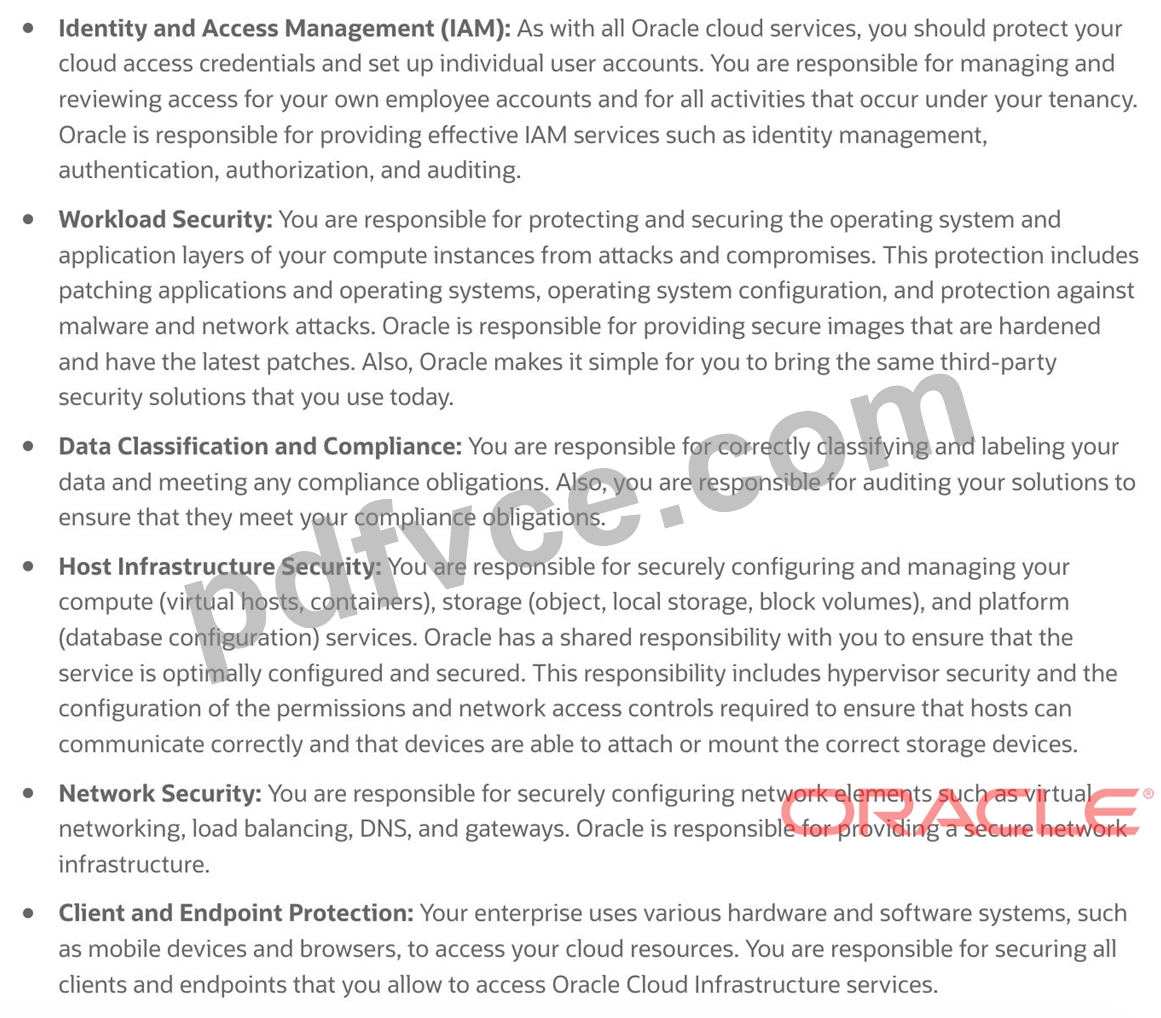
NEW QUESTION # 42
Which Oracle Cloud Infrastructure (OCI) capability allows you to set up alerts to notify you if a budget forecast exceeds or spending surpasses a certain amount?
- A. Events
- B. Budget
- C. Cost Analysis
- D. Monitoring
Answer: B
NEW QUESTION # 43
Which Oracle Cloud Infrastructure service allows you to run code without provisioning any underlying infrastructure resources?
- A. Oracle Container Engine for Kubernetes (OKE)
- B. Compute service
- C. Oracle Functions
- D. Storage Gateway
Answer: A
Explanation:
Oracle Functions is a fully managed, multi-tenant, highly scalable, on-demand, Functions-as-a-Service platform. It is built on enterprise-grade Oracle Cloud Infrastructure and powered by the Fn Project open source engine. Use Oracle Functions (sometimes abbreviated to just Functions) when you want to focus on writing code to meet business needs.
The serverless and elastic architecture of Oracle Functions means there's no infrastructure administration or software administration for you to perform. You don't provision or maintain compute instances, and operating system software patches and upgrades are applied automatically. Oracle Functions simply ensures your app is highly-available, scalable, secure, and monitored. With Oracle Functions, you can write code in Java, Python, Node, Go, and Ruby (and for advanced use cases, bring your own Dockerfile, and Graal VM). You can then deploy your code, call it directly or trigger it in response to events, and get billed only for the resources consumed during the execution.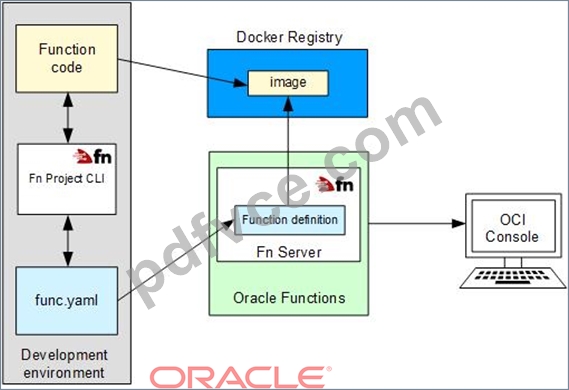
NEW QUESTION # 44
What purpose does an Oracle Cloud Infrastructure (OCI) Dynamic Routing Gateway Serve?
- A. Enable OCI Compute instances to connect to the internal
- B. Enables OCI Compute Instance to privately connect to OCI Object Storage
- C. Enables OCI Compute instances to be reached from internet
- D. Enables OCI Compute instance to connect to on-promises environments
Answer: D
Explanation:
You can think of a Dynamic Routing Gateway (DRG) as a virtual router that provides a path for private traffic (that is, traffic that uses private IPv4 addresses) between your VCN and networks outside the VCN's region.
For example, if you use an IPSec VPN or Oracle Cloud Infrastructure FastConnect (or both) to connect your on-premises network to your VCN, that private IPv4 address traffic goes through a DRG that you create and attach to your VCN. For scenarios for using a DRG to connect a VCN to your on-premises network, see Networking Scenarios. For important details about routing to your on-premises network, see Routing Details for Connections to Your On-Premises Network.
Also, if you decide to peer your VCN with a VCN in another region, your VCN's DRG routes traffic to the other VCN over a private backbone that connects the regions (without traffic traversing the internet). For information about connecting VCNs in different regions, see Remote VCN Peering (Across Regions).
NEW QUESTION # 45
Which is a key benefit of using oracle cloud infrastructure autonomous data warehouse?
- A. No username and password required
- B. Maintain root level acress to the underlying operating system
- C. Scale both CPU and Storage without downtime
- D. Apply database patches as they become available
Answer: C
Explanation:
Oracle Autonomous Data Warehouse is a cloud data warehouse service that eliminates virtually all the complexities of operating a data warehouse and securing data. It automates provisioning, configuring, securing, tuning, scaling, patching, backing up, and repairing of the data warehouse. Unlike other "fully managed" cloud data warehouse solutions that only patch and update the service, it also features elastic, automated scaling, performance tuning, security, and a broad set of built-in capabilities that enable machine learning analysis, simple data loading, and data visualizations.
Data Warehouse uses continuous query optimization, table indexing, data summaries, and auto-tuning to ensure consistent high performance even as data volume and number of users grows. Autonomous scaling can temporarily increase compute and I/O by a factor of three to maintain performance. Unlike other cloud services which require downtime to scale, Autonomous Data Warehouse scales while the service continues to run.
NEW QUESTION # 46
A company has developed an eCommerce web application In Oracle Cloud Infrastructure.
What should they do to ensure that the application has the highest level of resilience?
- A. Deploy the application across multiple Virtual Cloud Networks.
- B. Deploy the application across multiple Availability Domains and Fault Domains.
- C. Deploy the application across multiple Regions and Availability Domains.
- D. Deploy the application across multiple Availability Domains and subnet.
Answer: C
Explanation:
For highest level of resilience you can deploy the application between regions and distribute on availability domain and fault domains.
Reference:
https://www.oracle.com/cloud/iaas/faq.html
NEW QUESTION # 47
Which describes a key benefit of using Oracle Cloud Infrastructure (OCI)?
- A. Only bare metal workloads are supported on OCI.
- B. With OCI, you can run only cloud-native workloads.
- C. With OCI, you can only run Java based workloads on bare metal.
- D. OCI offers consistent performance with a predictable pricing model.
Answer: D
Explanation:
https://www.oracle.com/in/cloud/pricing.html
- OCI offers consistent performance with a predictable pricing model - is the best suited answer.
- Only bare metal workloads are supported in OCI - False, since you can work with VMs etc too
- With OCI, you can run cloud native workloads - False, since you can work with on-premise by connecting it to OCI too.
- With OCI, you can only run Java based workloads on bare metal - False since Java is not the only programming language supported by OCI.
NEW QUESTION # 48
Which statement accurately describes an Oracle Cloud Infrastructure Region?
- A. Each Availability Domain has three Fault Domains.
- B. Each region has a single Fault Domain.
- C. Each Fault Domain has multiple Availability Domains.
- D. Each Availability Domain has a single Fault Domain.
Answer: A
Explanation:
Oracle Cloud Infrastructure is hosted in regions and availability domains. A region is a localized geographic area, and an availability domain is one or more data centers located within a region. A region is composed of one or more availability domains. Most Oracle Cloud Infrastructure resources are either region-specific, such as a virtual cloud network, or availability domain-specific, such as a compute instance. Traffic between availability domains and between regions is encrypted.
Availability domains are isolated from each other, fault tolerant, and very unlikely to fail simultaneously. Because availability domains do not share infrastructure such as power or cooling, or the internal availability domain network, a failure at one availability domain within a region is unlikely to impact the availability of the others within the same region.
The availability domains within the same region are connected to each other by a low latency, high bandwidth network, which makes it possible for you to provide high-availability connectivity to the internet and on-premises, and to build replicated systems in multiple availability domains for both high-availability and disaster recovery.
A fault domain is a grouping of hardware and infrastructure within an availability domain. Each availability domain contains three fault domains. Fault domains provide anti-affinity: they let you distribute your instances so that the instances are not on the same physical hardware within a single availability domain. A hardware failure or Compute hardware maintenance event that affects one fault domain does not affect instances in other fault domains. In addition, the physical hardware in a fault domain has independent and redundant power supplies, which prevents a failure in the power supply hardware within one fault domain from affecting other fault domains.
NEW QUESTION # 49
Which is NOT available to you whenever Oracle Cloud Infrastructure creates or resolves an incident?
- A. Email notifications
- B. Webhook notifications
- C. Text Message notifications
- D. Twitter notifications
Answer: D
Explanation:
The Oracle Cloud Infrastructure Notifications service broadcasts messages to distributed components through a publish-subscribe pattern, delivering secure, highly reliable, low latency and durable messages for applications hosted on Oracle Cloud Infrastructure and externally. Use Notifications to get notified when event rules are triggered or alarms are breached, or to directly publish a message.
Messages sent out as email by the Oracle Cloud Infrastructure Notifications service are processed and delivered through Oracle resources Reference:
https://docs.cloud.oracle.com/en-us/iaas/Content/Notification/Concepts/notificationoverview.htm
NEW QUESTION # 50
Which gateway can be used to provide internet access to an Oracle Cloud Infrastructure compute instance in a private subnet?
- A. Service Gateway
- B. Internet Gateway
- C. NAT Gateway
- D. Dynamic Routing Gateway
Answer: C
Explanation:
A NAT gateway gives cloud resources without public IP addresses access to the internet without exposing those resources to incoming internet connections.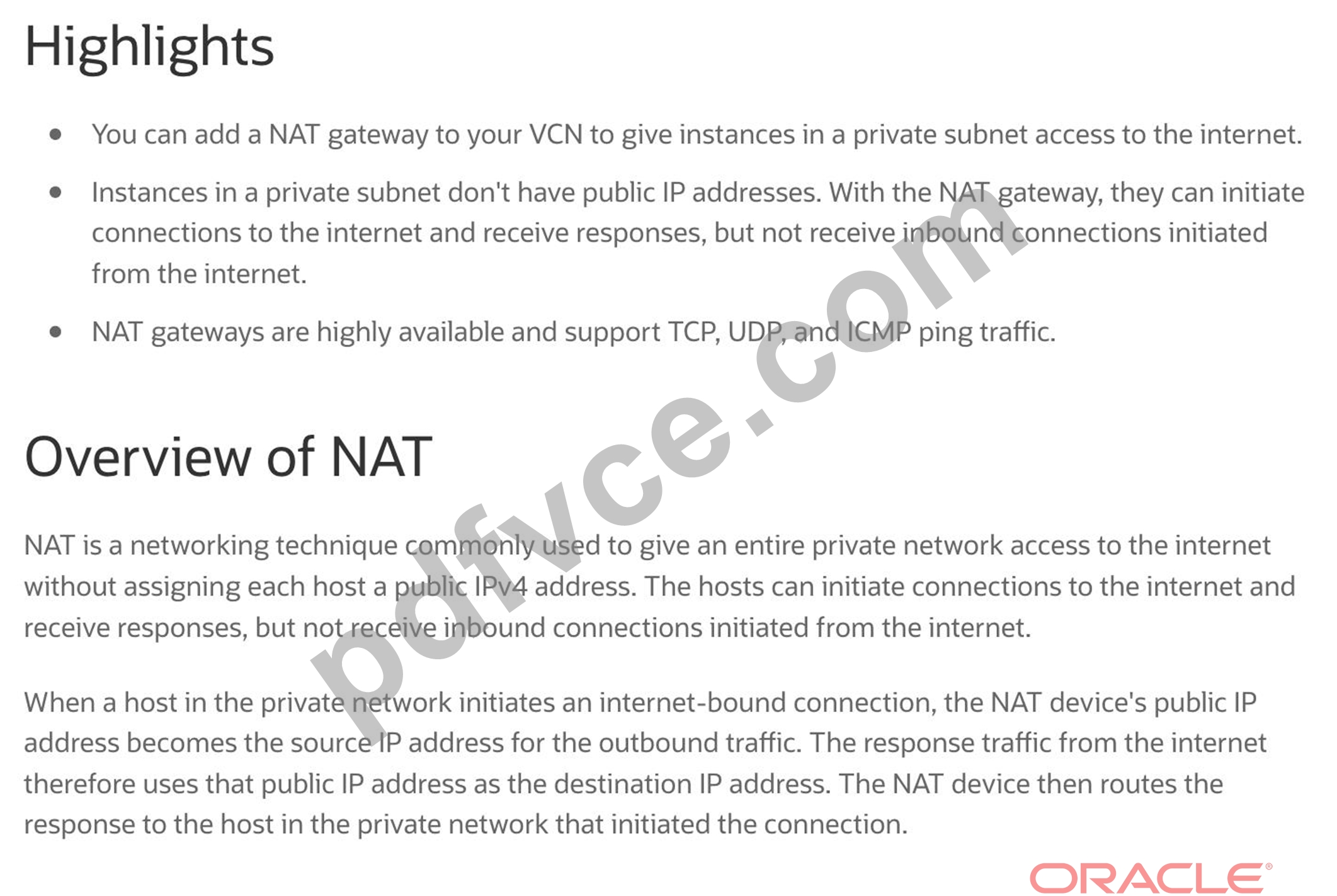
NEW QUESTION # 51
Which two situations incur costs in Oracle Cloud Infrastructure (OCI)?
- A. Transferring data across regions
- B. Transferring data from one instance to another across different Availibility Domains in a Region
- C. Data egress to the internet
- D. Transferring data from one instance to another in the same Availibility Domain
- E. Data ingress from the internet
Answer: A,C
NEW QUESTION # 52
You have an extremely high performance database workload that requires atleast 105 IOPS/GB and 100,000 IOPS per volume.
Which Oracle Cloud Infrastructure (OCI) Block Volume performance level can be used to meet this requirement?
- A. Ultra High Performance
- B. Higher Performance
- C. Balanced
- D. Lower cost
Answer: A
NEW QUESTION # 53
Which statement about the Oracle Cloud Infrastructure (OCI) shared-security model is true?
- A. You are not responsible for any aspect of security in OCI
- B. You are responsible for managing security controls within the physical OCI network
- C. You are responsible for securing the hypervisor within OCI compute service
- D. You are responsible for securing all data that you place in OCI
Answer: D
Explanation:
Explanation
Oracle Cloud Infrastructure offers best-in-class security technology and operational processes to secure its enterprise cloud services. However, for you to securely run your workloads in Oracle Cloud Infrastructure, you must be aware of your security and compliance responsibilities. By design, Oracle provides security of cloud infrastructure and operations (cloud operator access controls, infrastructure security patching, and so on), and you are responsible for securely configuring your cloud resources. Security in the cloud is a shared responsibility between you and Oracle.
In a shared, multi-tenant compute environment, Oracle is responsible for the security of the underlying cloud infrastructure (such as data-center facilities, and hardware and software systems) and you are responsible for securing your workloads and configuring your services (such as compute, network, storage, and database) securely.
In a fully isolated, single-tenant, bare metal server with no Oracle software on it, your responsibility increases as you bring the entire software stack (operating systems and above) on which you deploy your applications. In this environment, you are responsible for securing your workloads, and configuring your services (compute, network, storage, database) securely, and ensuring that the software components that you run on the bare metal servers are configured, deployed, and managed securely.
The responsibilities can be divided as:
NEW QUESTION # 54
Which TWO statements correctly describe Oracle Cloud Infrastructure (OCI) Service Level Agreements (SLAs)? (Choose all correct answers)
- A. Defined as a number of eights for a month and a percentage credit.
- B. financially backed commitment to provide a maximum level of service to customers.
- C. Defined as a number of eights for a week and a percentage credit.
- D. Financially backed commitment to provide a minimum level of service to customers.
- E. Defined as a number of nines for a month and a percentage credit.
- F. Defined as a number of nines for a week and a percentage credit.
Answer: D,E
NEW QUESTION # 55
You have a web application that receives 5X more traffic on the weekends than weekdays. You need to automatically match capacity to demand, while keeping the application up and running, and also saving cost.
Which Oracle Cloud Infrastructure (OCI) compute feature can be used to meet these requirements?
- A. Autoscaling
- B. Vertical Scaling
- C. Manual Scaling
- D. Parallel Scaling
Answer: A
NEW QUESTION # 56
Which service level agreement type is NOT offered by Oracle Cloud Infrastructure Compute service?
- A. Application Plane
- B. Performance
- C. Control Plane
- D. Data Plane
Answer: A
Explanation:
Oracle offers several different service level agreements as defined in this section (Service Level Agreements).Service level agreements range from least restrictive (data plane) to more restrictive (control plane) to most restrictive (performance).
Reference:
https://www.oracle.com/assets/paas-iaas-pub-cld-srvs-pillar-4021422.pdf
NEW QUESTION # 57
What does compute instance vertical scaling mean?
- A. Changing to a large or smaller shape
- B. Adding additional compute instances
- C. Providing Fault tolerance
- D. Enabling Disaster recovery
Answer: A
Explanation:
Changing the Shape of an Instance (Horizontal Scaling)
You can change the shape of a virtual machine (VM) instance without having to rebuild your instances or redeploy your applications. This lets you scale up your Compute resources for increased performance, or scale down to reduce cost.
Autoscaling (vertical scaling)
Autoscaling lets you automatically adjust the number of Compute instances in an instance pool based on performance metrics such as CPU utilization. This helps you provide consistent performance for your end users during periods of high demand, and helps you reduce your costs during periods of low demand.
As load increases, instances are automatically provisioned: the instance pool scales out. As load decreases, instances are automatically removed: the instance pool scales in.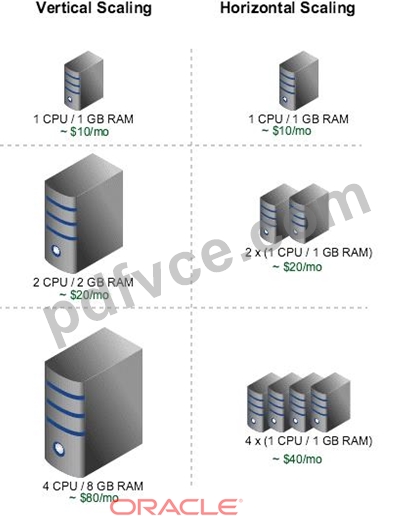
https://docs.cloud.oracle.com/en-us/iaas/Content/Compute/Tasks/resizinginstances.htm
NEW QUESTION # 58
......
The best 1z0-1085-22 exam study material and preparation tool is here: https://certification-questions.pdfvce.com/Oracle/1z0-1085-22-exam-pdf-dumps.html