

Get Special Discount Offer on DEA-C01 Dumps PDF [UPDATED Mar-2026]
PDF Download Snowflake Test To Gain Brilliante Result!
NEW QUESTION # 105
A healthcare company uses Amazon Kinesis Data Streams to stream real-time health data from wearable devices, hospital equipment, and patient records.
A data engineer needs to find a solution to process the streaming data. The data engineer needs to store the data in an Amazon Redshift Serverless warehouse. The solution must support near real-time analytics of the streaming data and the previous day's data.
Which solution will meet these requirements with the LEAST operational overhead?
- A. Load the data into Amazon S3. Use the COPY command to load the data into Amazon Redshift.
- B. Use the Amazon Aurora zero-ETL integration with Amazon Redshift.
- C. Use the streaming ingestion feature of Amazon Redshift.
- D. Load data into Amazon Kinesis Data Firehose. Load the data into Amazon Redshift.
Answer: C
Explanation:
https://docs.aws.amazon.com/redshift/latest/dg/materialized-view-streaming-ingestion.html Use the Streaming Ingestion Feature of Amazon Redshift: Amazon Redshift recently introduced streaming data ingestion, allowing Redshift to consume data directly from Kinesis Data Streams in near real-time. This feature simplifies the architecture by eliminating the need for intermediate steps or services, and it is specifically designed to support near real-time analytics. The operational overhead is minimal since the feature is integrated within Redshift.
NEW QUESTION # 106
A company stores details about transactions in an Amazon S3 bucket. The company wants to log all writes to the S3 bucket into another S3 bucket that is in the same AWS Region.
Which solution will meet this requirement with the LEAST operational effort?
- A. Configure an S3 Event Notifications rule for all activities on the transactions S3 bucket to invoke an AWS Lambda function. Program the Lambda function to write the events to the logs S3 bucket.
- B. Create a trail of data events in AWS CloudTraiL. Configure the trail to receive data from the transactions S3 bucket. Specify an empty prefix and write-only events. Specify the logs S3 bucket as the destination bucket.
- C. Configure an S3 Event Notifications rule for all activities on the transactions S3 bucket to invoke an AWS Lambda function. Program the Lambda function to write the event to Amazon Kinesis Data Firehose. Configure Kinesis Data Firehose to write the event to the logs S3 bucket.
- D. Create a trail of management events in AWS CloudTraiL. Configure the trail to receive data from the transactions S3 bucket. Specify an empty prefix and write-only events. Specify the logs S3 bucket as the destination bucket.
Answer: B
Explanation:
https://docs.aws.amazon.com/AmazonS3/latest/userguide/logging-with-S3.html
NEW QUESTION # 107
Melissa, Senior Data Engineer, looking out to optimize query performance for one of the Critical Control Dashboard, she found that most of the searches by the users on the control dashboards are based on Equality search on all the underlying columns mostly. Which Best techniques she should consider here?
- A. The search optimization service would best fit here as it can be applied to all underlying columns & speeds up equality searches.
(Correct) - B. A materialized view speeds both equality searches and range searches.
- C. Melissa can create Indexes & Hints on the searchable columns to speed up Equality search.
- D. She can go for clustering on underlying tables which can speedup Equality searches.
Answer: A
Explanation:
Explanation
Clustering a table can speed any of the following, as long as they are on the clustering key:
Range searches.
Equality searches.
However, a table can be clustered on only a single key (which can contain one or more columns or expressions).
The search optimization service speeds equality searches. However, this applies to all the columns of supported types in a table that has search optimization enabled. This is what required here& best fit for purpose.
A materialized view speeds both equality searches and range searches, as well as some sort opera-tions, but only for the subset of rows and columns included in the materialized view.
NEW QUESTION # 108
A company is creating a new data pipeline to populate a data lake. A data analyst needs to prepare and standardize the data before a data engineering team can perform advanced data transformations. The data analyst needs a solution to process the data that does not require writing new code.
Which solution will meet these requirements with the LEAST operational effort?
- A. Use AWS Glue Studio with data preparation recipe transformations. Ensure that the data engineers add additional transformations to complete the pipeline.
- B. Use Python and Pandas in an AWS Glue Studio notebook. Ensure that the data engineers add additional transformations to complete the pipeline.
- C. Create a document that includes the data preparation rules. Ensure that the data engineers implement the rules in AWS Glue.
- D. Use Amazon SageMaker Canvas and SageMaker Data Wrangler to write to a new dataset.
Ensure that the data engineers add additional transformations to complete the pipeline by using AWS Glue.
Answer: A
Explanation:
AWS Glue Studio lets analysts build no-code/low-code visual ETL with built-in preparation transformations (recipe-style), producing Glue jobs that engineers can extend - minimizing coding and operational overhead.
NEW QUESTION # 109
A mobile gaming company wants to capture data from its gaming app. The company wants to make the data available to three internal consumers of the data. The data records are approximately 20 KB in size.
The company wants to achieve optimal throughput from each device that runs the gaming app.
Additionally, the company wants to develop an application to process data streams. The stream- processing application must have dedicated throughput for each internal consumer.
Which solution will meet these requirements?
- A. Configure the mobile app to use the Amazon Kinesis Producer Library (KPL) to send data to Amazon Kinesis Data Firehose. Use the enhanced fan-out feature with a stream for each internal consumer.
- B. Configure the mobile app to call the PutRecords API operation to send data to Amazon Kinesis Data Streams. Host the stream-processing application for each internal consumer on Amazon EC2 instances. Configure auto scaling for the EC2 instances.
- C. Configure the mobile app to call the PutRecordBatch API operation to send data to Amazon Kinesis Data Firehose. Submit an AWS Support case to turn on dedicated throughput for the company's AWS account. Allow each internal consumer to access the stream.
- D. Configure the mobile app to call the PutRecords API operation to send data to Amazon Kinesis Data Streams. Use the enhanced fan-out feature with a stream for each internal consumer.
Answer: D
NEW QUESTION # 110
What kind of Snowflake integration is required when defining an external function in Snowflake?
- A. Security integration
- B. HTTP integration
- C. Notification integration
- D. API integration
Answer: D
Explanation:
Explanation
An API integration is required when defining an external function in Snowflake. An API integration is a Snowflake object that defines how Snowflake communicates with an externalservice via HTTPS requests and responses. An API integration specifies parameters such as URL, authentication method, encryption settings, request headers, and timeout values. An API integration is used to create an external function object that invokes the external service from within SQL queries.
NEW QUESTION # 111
A data engineer needs to create an Amazon Athena table based on a subset of data from an existing Athena table named cities_world. The cities_world table contains cities that are located around the world. The data engineer must create a new table named cities_us to contain only the cities from cities_world that are located in the US.
Which SQL statement should the data engineer use to meet this requirement?
- A. INSERT INTO cities_usa SELECT city, state FROM cities_world WHERE country='usa';
- B. MOVE city, state FROM cities_world TO cities_usa WHERE country='usa';
- C. UPDATE cities_usa SET (city, state) = (SELECT city, state FROM cities_world WHERE country='usa');
- D. INSERT INTO cities_usa (city,state) SELECT city, state FROM cities_world WHERE country='usa';
Answer: D
NEW QUESTION # 112
By default, a newly-created Custom role is not assigned to any user, nor granted to any other role?
- A. FALSE
- B. TRUE
Answer: B
NEW QUESTION # 113
A company wants to ingest streaming data into an Amazon Redshift data warehouse from an Amazon Managed Streaming for Apache Kafka (Amazon MSK) cluster. A data engineer needs to develop a solution that provides low data access time and that optimizes storage costs.
Which solution will meet these requirements with the LEAST operational overhead?
- A. Develop an AWS Glue streaming extract, transform, and load (ETL) job to process the incoming data from Amazon MSK. Load the data into Amazon S3. Use Amazon Redshift Spectrum to read the data from Amazon S3.
- B. Create an external schema that maps to the streaming data source. Create a new Amazon Redshift table that references the external schema.
- C. Create an Amazon S3 bucket. Ingest the data from Amazon MSK. Create an event-driven AWS Lambda function to load the data from the S3 bucket to a new Amazon Redshift table.
- D. Create an external schema that maps to the MSK cluster. Create a materialized view that references the external schema to consume the streaming data from the MSK topic.
Answer: A
Explanation:
By using a serverless Glue streaming job to continuously pull your MSK records, transform them as needed, and land them in Parquet (or another columnar) files in S3, you:
1. Optimize storage costs ?your data sits in S3, where you pay pennies per GB-month and can tier it further with lifecycle rules.
2. Get low-latency access ?Redshift Spectrum lets you query S3-backed tables with millisecond planning time, so freshly landed data becomes queryable almost immediately.
3. Minimize ops overhead ?you don't have to stand up or manage any EC2-based brokers, Lambda polling loops, or custom connector infrastructure.
Glue's managed streaming runtime handles checkpointing, autoscaling, and fault tolerance for you.
Once the data lands in S3, you simply define an external schema in Redshift that points at the Glue Data Catalog database where your streaming job writes tables. Analysts can then query the
"live" dataset via Spectrum as if it were inside Redshift, meeting both your performance and cost goals with minimal operational effort.
NEW QUESTION # 114
A company wants to migrate a data warehouse from Teradata to Amazon Redshift.
Which solution will meet this requirement with the LEAST operational effort?
- A. Use AWS Database Migration Service (AWS DMS) to migrate the data. Use automatic schema conversion.
- B. Use the AWS Schema Conversion Tool (AWS SCT) to migrate the schema. Use AWS Database Migration Service (AWS DMS) to migrate the data.
- C. Use AWS Database Migration Service (AWS DMS) Schema Conversion to migrate the schema.
Use AWS DMS to migrate the data. - D. Manually export the schema definition from Teradata. Apply the schema to the Amazon Redshift database. Use AWS Database Migration Service (AWS DMS) to migrate the data.
Answer: B
Explanation:
This solution provides the least operational effort for migrating a data warehouse from Teradata to Amazon Redshift by using AWS services that are specifically designed for schema and data migration:
AWS Schema Conversion Tool (SCT) is used to convert and migrate the schema from Teradata to Amazon Redshift, handling schema differences automatically and reducing manual work.
AWS Database Migration Service (DMS) is then used to transfer the data from Teradata to Redshift, allowing for efficient data migration.
NEW QUESTION # 115
A company runs multiple applications on AWS. The company configured each application to output logs. The company wants to query and visualize the application logs in near real time.
Which solution will meet these requirements?
- A. Configure the applications to output logs to Amazon CloudWatch Logs log groups. Create an Amazon S3 bucket. Create an AWS Lambda function that runs on a schedule to export the required log groups to the S3 bucket. Use Amazon Athena to query the log data in the S3 bucket.
- B. Configure the applications to output logs to Amazon CloudWatch Logs log groups. Use CloudWatch log anomaly detection to query and visualize the log data.
- C. Update the application code to send the log data to Amazon QuickSight by using Super-fast, Parallel, In-memory Calculation Engine (SPICE).Create the required analyses and dashboards in QuickSight.
- D. Create an Amazon OpenSearch Service domain. Configure the applications to output logs to Amazon CloudWatch Logs log groups. Create an OpenSearch Service subscription filter for each log group to stream the data to OpenSearch. Create the required queries and dashboards in OpenSearch Service to analyze and visualize the data.
Answer: D
Explanation:
By streaming your CloudWatch Logs log groups directly into an Amazon OpenSearch Service domain via subscription filters, you get near-real-time indexing and can build Kibana dashboards for querying and visualization with virtually no batching delays. This fully managed pipeline minimizes custom glue code and meets your requirements with low operational overhead.
NEW QUESTION # 116
A Data Engineer is trying to load the following rows from a CSV file into a table in Snowflake with the following structure: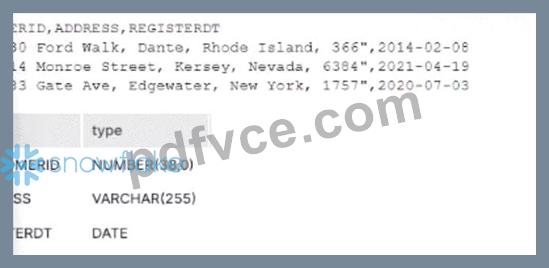
....engineer is using the following COPY INTO statement:
However, the following error is received.
Which file format option should be used to resolve the error and successfully load all the data into the table?
- A. ERROR_ON_COLUMN_COUKT_MISMATCH = FALSE
- B. FIELD OPTIONALLY ENCLOSED BY = " "
- C. FIELD_DELIMITER = ","
- D. ESC&PE_UNENGLO9ED_FIELD = '\\'
Answer: B
Explanation:
Explanation
The file format option that should be used to resolve the error and successfully load all the data into the table is FIELD_OPTIONALLY_ENCLOSED_BY = '"'. This option specifies that fields in the file may be enclosed by double quotes, which allows for fields that contain commas or newlines within them. For example, in row 3 of the file, there is a field that contains a comma within double quotes: "Smith Jr., John". Without specifying this option, Snowflake will treat this field as two separate fields and cause an error due to column count mismatch. By specifying this option, Snowflake will treat this field as one field and load it correctly into the table.
NEW QUESTION # 117
You can execute zero, one, or more transactions inside a stored procedure?
- A. FALSE
- B. TRUE
Answer: B
NEW QUESTION # 118
Data Engineer identified use case where he decided to use materialized view for query perfor-mance. Which one is not the limitation he must be aware of before using MVs in their use case?
- A. Truncating a materialized view is not supported.
- B. A materialized view can query only a single table & Joins, including self-joins, are not supported.
- C. Context Functions like CURRENT_TIME or CURRENT_TIMESTAMP is not per-mitted.
- D. Time Travel is not currently supported on materialized views.
- E. A materialized views does not support clustering.
- F. A materialized view cannot include HAVING clauses OR ORDER BY clause.
- G. A materialized views cannot be created on Shared Data.
- H. You cannot directly clone a materialized view by using the CREATE MATERIAL-IZED VIEW ...
CLONE... command.
Answer: E,F
Explanation:
Explanation
Defining a clustering key on a materialized view is supported and can increase performance in many situations. However, it also adds costs.
If you cluster both the materialized view(s) and the base table on which the materialized view(s) are defined, you can cluster the materialized view(s) on different columns from the columns used to cluster the base table.
You can create a materialized view on shared data.
Also You can use Snowflake's data sharing feature to share a materialized view.
Rest all are correct.
NEW QUESTION # 119
Two data engineering teams use separate AWS accounts. Both teams request access to the same datashare in an Amazon Redshift cluster that is in a third AWS account. The datashare is named salesshare.
A data engineer must use the Amazon Redshift SQL interface to grant both data engineering teams' access to the datashare.
Which command or commands will meet this requirement?
- A. GRANT USAGE ON DATASHARE salesshare TO ACCOUNTS '<account ID 1>' AND '<account ID 2>';
- B. GRANT USAGE ON DATASHARE salesshare TO NAMESPACE '<account ID 1>';
GRANT USAGE ON DATASHARE salesshare TO NAMESPACE '<account ID 2>'; - C. GRANT USAGE ON DATASHARE salesshare TO ACCOUNT '<account ID 1>';
GRANT USAGE ON DATASHARE salesshare TO ACCOUNT '<account ID 2>'; - D. GRANT USAGE ON DATASHARE salesshare TO NAMESPACES '<account ID 1>' AND
'<account ID 2>';
Answer: B
Explanation:
In Amazon Redshift data sharing, cross-account permissions for a datashare are granted to consumer cluster/serverless namespaces. Granting USAGE on the datashare to each consumer namespace enables both teams' Redshift environments in their respective accounts to create and query databases from the shared data.
NEW QUESTION # 120
A retail company uses Amazon Aurora PostgreSQL to process and store live transactional data.
The company uses an Amazon Redshift cluster for a data warehouse.
An extract, transform, and load (ETL) job runs every morning to update the Redshift cluster with new data from the PostgreSQL database. The company has grown rapidly and needs to cost optimize the Redshift cluster.
A data engineer needs to create a solution to archive historical data. The data engineer must be able to run analytics queries that effectively combine data from live transactional data in PostgreSQL, current data in Redshift, and archived historical data. The solution must keep only the most recent 15 months of data in Amazon Redshift to reduce costs.
Which combination of steps will meet these requirements? (Choose two.)
- A. Schedule a monthly job to copy data that is older than 15 months to Amazon S3 by using the UNLOAD command. Delete the old data from the Redshift cluster. Configure Amazon Redshift Spectrum to access historical data in Amazon S3.
- B. Configure the Amazon Redshift Federated Query feature to query live transactional data that is in the PostgreSQL database.
- C. Configure Amazon Redshift Spectrum to query live transactional data that is in the PostgreSQL database.
- D. Schedule a monthly job to copy data that is older than 15 months to Amazon S3 Glacier Flexible Retrieval by using the UNLOAD command. Delete the old data from the Redshift cluster. Configure Redshift Spectrum to access historical data from S3 Glacier Flexible Retrieval.
- E. Create a materialized view in Amazon Redshift that combines live, current, and historical data from different sources.
Answer: A,B
Explanation:
Choice A ensures that live transactional data from PostgreSQL can be accessed directly within Redshift queries.
Choice C archives historical data in Amazon S3, reducing storage costs in Redshift while still making the data accessible via Redshift Spectrum.
NEW QUESTION # 121
Assuming that the session parameter USE_CACHED_RESULT is set to false, what are characteristics of Snowflake virtual warehouses in terms of the use of Snowpark?
- A. Creating a DataFrame from a staged file with the read () method will start a virtual warehouse
- B. Transforming a DataFrame with methods like replace () will start a virtual warehouse -
- C. Creating a DataFrame from a table will start a virtual warehouse
- D. Calling a Snowpark stored procedure to query the database with session, call () will start a virtual warehouse
Answer: C
Explanation:
Explanation
Creating a DataFrame from a table will start a virtual warehouse because it requires reading data from Snowflake. The other options will not start a virtual warehouse because they either operate on local data or use an existing session to query Snowflake.
NEW QUESTION # 122
A company loads transaction data for each day into Amazon Redshift tables at the end of each day. The company wants to have the ability to track which tables have been loaded and which tables still need to be loaded.
A data engineer wants to store the load statuses of Redshift tables in an Amazon DynamoDB table. The data engineer creates an AWS Lambda function to publish the details of the load statuses to DynamoDB.
How should the data engineer invoke the Lambda function to write load statuses to the DynamoDB table?
- A. Use a second Lambda function to invoke the first Lambda function based on Amazon CloudWatch events.
- B. Use the Amazon Redshift Data API to publish a message to an Amazon Simple Queue Service (Amazon SQS) queue. Configure the SQS queue to invoke the Lambda function.
- C. Use a second Lambda function to invoke the first Lambda function based on AWS CloudTrail events.
- D. Use the Amazon Redshift Data API to publish an event to Amazon EventBridge. Configure an EventBridge rule to invoke the Lambda function.
Answer: D
Explanation:
https://docs.aws.amazon.com/redshift/latest/mgmt/data-api-monitoring-events.html
NEW QUESTION # 123
A company needs to implement a data mesh architecture in which domains for trading, risk, and compliance teams each have own their data. The teams need to share specific views with one another. The teams have over 1,000 tables across 50 databases in AWS Glue Data Catalog. All three teams use Amazon Athena to perform on-demand analysis. The teams use Amazon Redshift to generate complex reports. The compliance team must audit all data access. Access to personally identifiable information (PII) data must be restricted.
The company requires a scalable solution to meet the team requirements. The solution must provide the ability to perform analysis across team domains.
Which solution will meet these requirements?
- A. Use AWS Glue Data Catalog views to perform analysis. Use AWS CloudTrail logs to audit data access. Use AWS Lake Formation to manage access permissions. Use security definer views to mask PII.
- B. Use AWS Lake Formation to set up cross-domain access to tables. Set up fine-grained access controls.
- C. Create views in Athena for on-demand analysis. Use the Athena views in Amazon Redshift to perform cross-domain analytics. Use AWS CloudTrail to audit data access. Use AWS Lake Formation to establish fine-grained access control.
- D. Create materialized views and enable Amazon Redshift datashares for each domain. Configure cross-domain access policies.
Answer: B
Explanation:
AWS Lake Formation provides centralized, fine-grained governance (LF-Tags, column/row-level permissions) across domains, integrates with Athena and Redshift for cross-domain analytics, and supports comprehensive auditing via Lake Formation access logs and CloudTrail meeting scalability, PII restriction, and audit requirements.
NEW QUESTION # 124
Select the Incorrect statement about External Functions in SnowFlake?
- A. An external function does not contain its own code; instead, the external function calls code that is stored and executed outside Snowflake.
- B. Inside Snowflake, the external function is stored as a API Integration object.
- C. An external function is a type of UDF.
- D. Inside Snowflake, the external function is stored as a database object that contains in-formation that Snowflake uses to call the remote service.
Answer: B
NEW QUESTION # 125
A data engineer maintains a materialized view that is based on an Amazon Redshift database.
The view has a column named load_date that stores the date when each row was loaded.
The data engineer needs to reclaim database storage space by deleting all the rows from the materialized view.
Which command will reclaim the MOST database storage space?
- A. DELETE FROM materialized_view_name where load_date<=current_date
- B. VACUUM table_name where load_date<=current_date materializedview
- C. DELETE FROM materialized_view_name where 1=1
- D. TRUNCATE materialized_view_name
Answer: D
NEW QUESTION # 126
A data engineer configures a large number of AWS Glue jobs that all start up around the same time. All the jobs run for less than 1 hour in the same subnet of the same VPC. All the AWS Glue jobs run on a G1.X worker type.
Some of the jobs occasionally fail with the following error: "The specified subnet does not have enough free addresses to satisfy the request".
What is the likely root cause of the error?
- A. There are not enough IP addresses in the subnet.
- B. AWS Glue does not have the correct IAM permissions to add additional IP addresses to the subnet.
- C. The G1.X worker type cannot access the subnet.
- D. There are not enough IP addresses in the VPC.
Answer: A
Explanation:
Each AWS Glue worker requires an elastic network interface (ENI) and consumes an IP address in the subnet. When a large number of Glue jobs start simultaneously, the subnet can run out of available IP addresses. This causes the error "The specified subnet does not have enough free addresses." The root cause is insufficient IPs in the subnet, not the VPC overall.
NEW QUESTION # 127
A company stores its processed data in an S3 bucket. The company has a strict data access policy. The company uses IAM roles to grant teams within the company different levels of access to the S3 bucket.
The company wants to receive notifications when a user violates the data access policy. Each notification must include the username of the user who violated the policy.
Which solution will meet these requirements?
- A. Use AWS CloudTrail to track object-level events for the S3 bucket. Forward events to Amazon CloudWatch to set up CloudWatch alarms.
- B. Use Amazon CloudWatch metrics to gather object-level metrics. Set up CloudWatch alarms.
- C. Use AWS Config rules to detect violations of the data access policy. Set up compliance alarms.
- D. Use Amazon S3 server access logs to monitor access to the bucket. Forward the access logs to an Amazon CloudWatch log group. Use metric filters on the log group to set up CloudWatch alarms.
Answer: A
Explanation:
AWS CloudTrail provides detailed logging of AWS API calls, including object-level events for Amazon S3. You can configure CloudTrail to track data events for the S3 bucket, which will log each access to the objects in the bucket, including the username of the IAM entity (user or role) that accessed the data. By forwarding these CloudTrail events to Amazon CloudWatch, you can set up alarms to trigger notifications when policy violations are detected, and include the violating user's identity.
AWS Config is primarily designed for monitoring resource configurations, not for tracking real- time access events like data access violations. It does not directly provide information about which user accessed the S3 objects.
CloudWatch metrics can monitor S3 storage or request metrics, but it does not provide detailed logging of object-level access, including the username of the violator. You need CloudTrail to get detailed event information.
While S3 server access logs can track access to objects, they lack real-time processing and do not provide the same level of detail as CloudTrail.
Additionally, processing access logs with CloudWatch metric filters adds more complexity compared to using CloudTrail, which is designed for this use case.
NEW QUESTION # 128
A data engineer needs to maintain a central metadata repository that users access through Amazon EMR and Amazon Athena queries. The repository needs to provide the schema and properties of many tables. Some of the metadata is stored in Apache Hive. The data engineer needs to import the metadata from Hive into the central metadata repository.
Which solution will meet these requirements with the LEAST development effort?
- A. Use the AWS Glue Data Catalog.
- B. Use Amazon EMR and Apache Ranger.
- C. Use a Hive metastore on an EMR cluster.
- D. Use a metastore on an Amazon RDS for MySQL DB instance.
Answer: A
Explanation:
https://aws.amazon.com/blogs/big-data/metadata-classification-lineage-and-discovery-using- apache-atlas-on-amazon-emr/
NEW QUESTION # 129
......
DEA-C01 Dumps are Available for Instant Access: https://certification-questions.pdfvce.com/Snowflake/DEA-C01-exam-pdf-dumps.html